


Part 2 of a four-part series highlighting the Marcellus Shale Coalition’s four key industry priorities: capitalizing on downstream opportunities, infrastructure buildout, clean and efficient energy development, and operational certainty.
Pennsylvania produces more natural gas than almost anywhere else on earth. Moving it where it needs to go is another story. At more than 7 trillion cubic feet of natural gas annually, the Commonwealth ranks as the nation’s second-largest producer – powering homes, businesses, and industries well beyond its own borders. But being a prodigious producer only matters if you can transport the natural gas to where it is needed.
As the second installment in this four-part series, the focus turns from the demand driving Pennsylvania’s energy future to the infrastructure required to meet it. Without the pipelines, processing facilities and delivery systems to move that gas efficiently, the resource’s full value remains locked underground.
The gap between what Pennsylvania can produce and what it can reliably deliver has nothing to do with technical feasibility. Pipelines are the safest and most efficient way to move energy, a fact reinforced by Keith Coyle from the Pipeline and Hazardous Materials Safety Administration (PHMSA) during MSC’s annual SHALE INSIGHT 2026 ® conference.
It is, instead, a policy problem, and one that politicians are finally waking up to, now that their constituents – the American consumer – are facing a reckoning over energy affordability. And the cost of that gap is measured in real dollars and real risk for families and communities across the region.
In fact, it’s become so dire that even Massachusetts Governor Maura Healey is publicly urging federal lawmakers to increase gas supply in New England in an effort to “bring real savings to customers.” This is the same Governor who, as Attorney General, opposed efforts to expand natural gas pipeline infrastructure into the region. The consequences of years of constrained pipeline capacity are now being felt by New England families and businesses through higher energy costs and growing concerns about reliability.
“The energy affordability and reliability challenges facing New England today…are a direct result of politically motivated decisions to deny consumers in the region from accessing abundant and clean Pennsylvania natural gas,” MSC President Jim Welty responded bluntly.
“Years of misguided policy decisions prevented the development of the critical energy infrastructure needed to safely deliver that resource to consumers.”
A Cold Reminder of What Is at Stake
When Winter Storm Fern swept across the country in early 2026, it offered one of the clearest demonstrations of why energy infrastructure buildout is a matter of public safety.
Natural gas generated approximately 40% of regional grid operator PJM Interconnection’s electricity during the storm – and more than 60% right here in Pennsylvania – while also directly heating more than half of the Commonwealth’s homes. As the nation’s third-largest electricity generator and leading exporter, Pennsylvania plays a critical role in powering the region. When Winter Storm Fern put our energy infrastructure to the test, our state’s abundant natural gas resources delivered when they were needed most.
The story in New England, however, was very different. Despite an abundance of affordable, readily-available natural gas located just a few hundred miles to the south in Pennsylvania, inadequate pipeline infrastructure once again left New England relying on costly imported foreign liquefied natural gas to meet demand during Winter Storm Fern. The result cost residents and businesses big time. According to S&P Global:
- Pipeline bottlenecks have increased natural gas prices by as much as 160% in major cities such as Boston, New York City, and Chicago;
- Expanding pipeline capacity out of Pennsylvania could save American consumers an estimated $5.5 billion annually.
The Bottleneck Problem for Operators
“The pipeline constraints in Appalachia are second to none. Our operators are feeling the constraints of that infrastructure,” Welty told Natural Gas Intelligence.
For a state sitting atop one of the world’s most prolific natural gas formations, this is a failure to fully realize the economic benefits that Pennsylvania’s natural gas resources make possible.
The infrastructure constraints have a measurable impact on the industry:
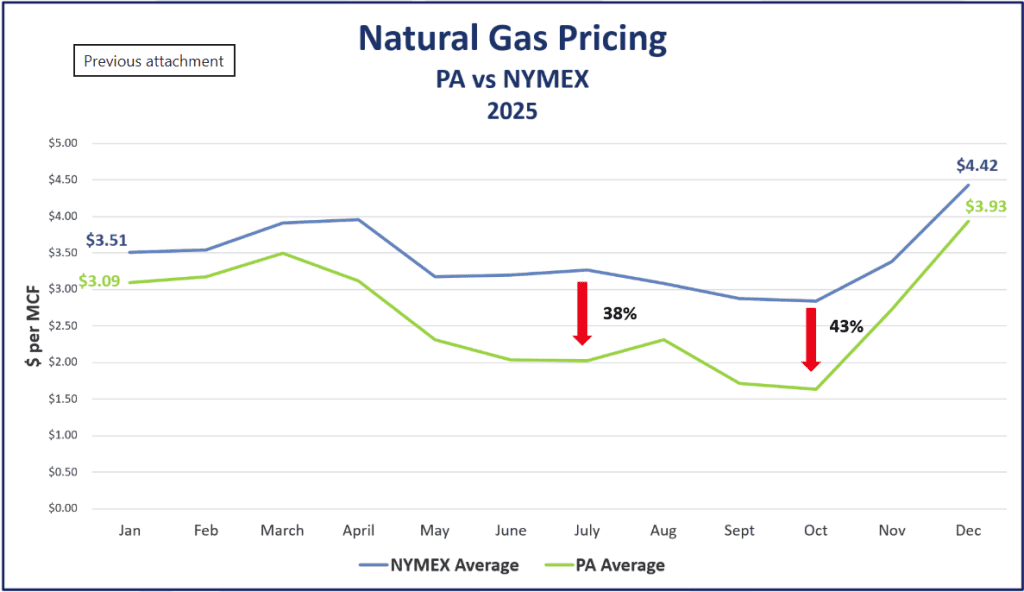
- Because Pennsylvania producers cannot get their gas out of the Basin, they have received, on average, 20% less for their natural gas than standard NYMEX and Henry Hub price benchmarks.
- Consistently falling short of that benchmark means an enormous amount of unrealized value for producers, workers, royalty owners, and the broader regional economy.
Critics often focus on the cost of infrastructure investments without accounting for the economic cost of not building them. Pipeline constraints suppress the value of Pennsylvania-produced natural gas for royalty owners, limit market access, discourage investment, and prevent consumers in energy-constrained regions from accessing lower-cost supplies.
The Marcellus and Utica formations still hold enormous, untapped potential, but our pipeline infrastructure has not kept pace with the opportunity. The solution is achievable through regulatory and policy changes that allow us to get our gas to market.
A Decade of Obstruction
The record of recent years tells a discouraging story: Nine of the last ten pipeline projects that would have meaningfully benefited Pennsylvania’s economy – not to mention delivering essential energy savings to Americans – were cancelled or withdrawn before completion. The tenth, the Mountain Valley Pipeline, required a direct act of Congress to cross the finish line after more than nine years of deliberation.
The Constitution Pipeline is perhaps the most pointed example of what obstructionist policy looks like in practice. That project would have carried Pennsylvania natural gas north into New England, directly addressing the reason that region pays up to 80% more for energy than consumers in states with adequate pipeline infrastructure. After years of permitting purgatory amid regulatory opposition in New York, the project was ultimately withdrawn.
Despite these roadblocks, demand for additional infrastructure has not disappeared. Companies and policymakers across the Northeast continue pursuing expansions aimed at improving reliability, enhancing energy security, and increasing access to affordable energy through domestic natural gas delivery.
Building the Path Forward
Pennsylvania has already taken meaningful steps to improve permitting certainty. In 2025, state leaders advanced historic reforms through the state budget, including deemed-approved permits and an expansion of the SPEED third-party review program, helping provide greater certainty for businesses looking to invest and build in the Commonwealth.
Now, attention has shifted to the federal level. The bipartisan American Affordability and Jobs Act seeks to address longstanding federal permitting barriers that have delayed pipelines, power generation, and other critical energy infrastructure across Appalachia. At a time of rising electricity demand and growing competition for investment, the ability to move projects from permit to construction has become increasingly important.
Pennsylvania has the advantage of abundance. Turning that advantage into economic opportunity depends on what happens next in the permitting process.
