


There’s a particular art form in some corners of research: say something alarming enough to generate headlines while hedging every claim so thoroughly that you’ve said almost nothing at all.
It’s a pattern we see regularly, where studies are packaged into fear mongering press releases designed to generate coverage and, in some cases, drive opinion and policies that the underlying data simply doesn’t support.
Read more: Health & Environmental Impacts Studies Fact Sheet ; ***NEW DATA: PA DEP Finds “No Risk to Human Health” From Shale Gas Waste***
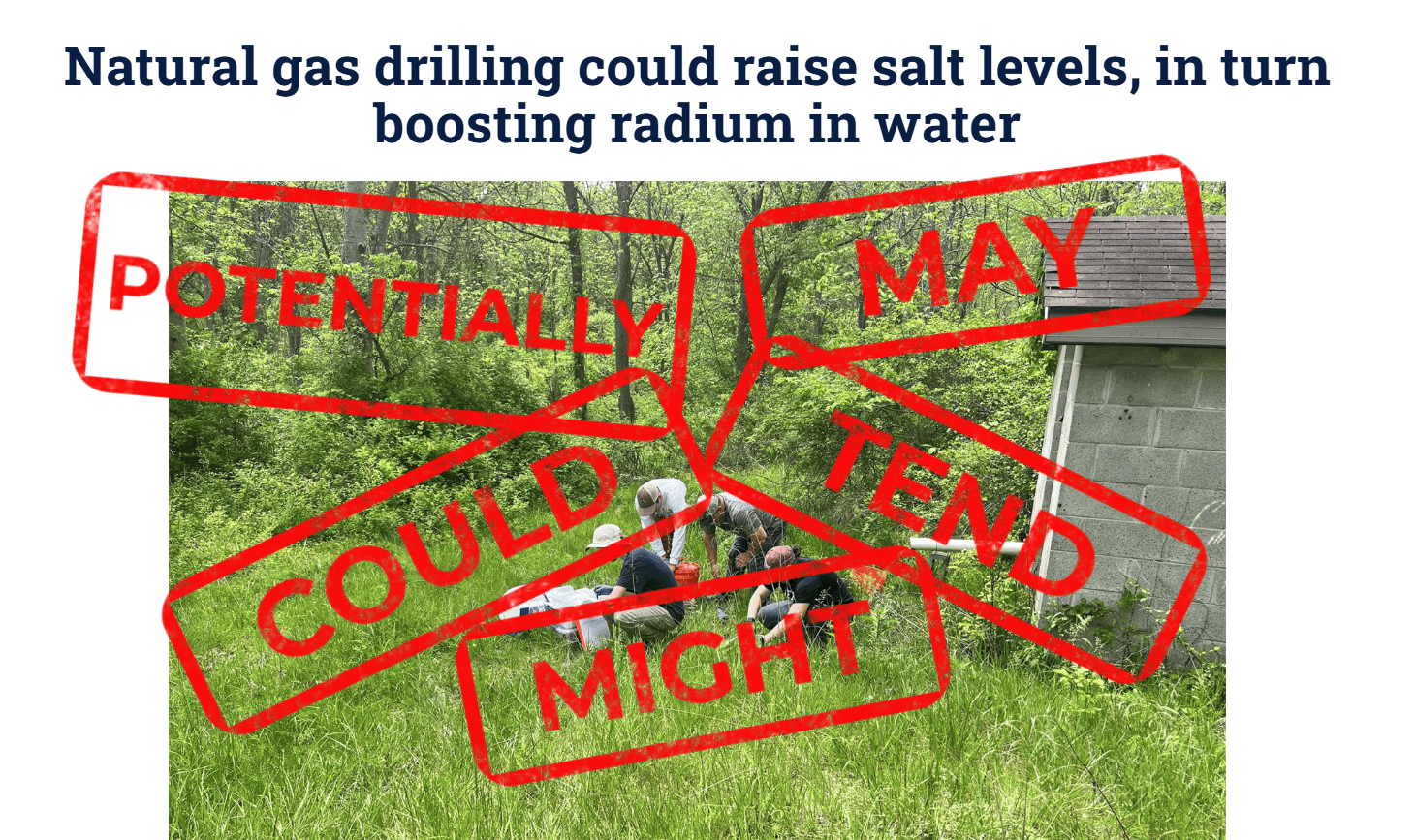
A recent study on radium, salinity, and natural gas drilling in southwestern Pennsylvania is a textbook case. The headline: “Natural gas drilling could raise salt levels, in turn boosting radium in water.”
Yet, this supposition – that it “could” raise salt levels – is contradicted by the researchers’ own words: “Radium activities in all of our samples are below regulatory levels.”
In total, 91 wells were sampled and all 91 fell within U.S. Environmental Protection Agency (EPA) limits with the primary source of radium identified as natural shallow aquifer geology. The headline and the study’s data tell two very different stories.
What the Study Actually Found
The findings, taken on their own terms, are fairly straightforward. All 91 sampled wells came in below EPA maximum contaminant levels for radium. Only six of those 91 wells “could potentially be associated” with drilling activity, meaning 93% showed none.
So, what does “could potentially be associated with” even mean? In short, the researchers’ hypothesis didn’t materialize, leaving them only with unverified speculation.
Not convinced? Take the researchers’ own words: “We evaluated radium sources and determined that the primary source of radium is the geogenic shallow aquifer matrix and not dilution of UOG Marcellus-produced water.” (emphasis added).
This conclusion, which “could potentially” undermine the authors’ apparent agenda, was omitted from the press release.
A Study in Saying Nothing Confidently
What makes this particular paper worth examining isn’t just the findings. It’s the architecture of the language used to present them. The press release alone contains 16 instances of hedging language. The full study adds 33 more.
The word “could” appears 13 times in the study and four times in the press release, including the headline.
“Potential” or “potentially” appear 9 times. “May” and “hypothesize” are used to connect drilling activity to radium without any direct evidence.
The logical chain the study constructs runs something like this: drilling operations could cause surface spills, surface spills may raise salinity levels, higher salinity might mobilize radium, and mobilized radium could potentially pose a health risk.
Four links, every one of them conditioned. The correlation the researchers did identify was explicitly described as “weak” and “not significant enough to cite as a broad correlation.” What that adds up to is a hypothesis in a press release costume, not a finding.
“Fracking” Didn’t Do It — And the Study Knows It
The word “fracking” appears in both the headline and the press release. It shouldn’t.
Hydraulic fracturing occurs a mile or more underground. The contamination pathway the researchers hypothesized runs through surface spills and releases, which is an entirely different mechanism with no demonstrated connection to the subsurface fracturing process. Using the term in this context is inaccurate, and it’s inaccurate by the study’s own logic.
The study’s geochemical fingerprinting actually found salinity signatures inconsistent with deep Marcellus-produced water, further undercutting the implied connection. One of the researchers, Nathaniel Warner, acknowledged that in the press release:
“Radium levels tend to increase in areas with higher salinity, but that salinity can come from a host of other factors,” Warner said. “Road salt, nearby septic tanks, even animal waste can all contribute to increasing salinity in an area.”
Those contributors are mentioned in the study. They are absent from the headline.
It’s also worth noting that Pennsylvania operators recycle and reuse more than 90% of produced water, which significantly undermines the surface spill hypothesis to begin with.
Recent data from the Pennsylvania Department of Environmental Protection reinforces the point, finding no evidence that oil and gas waste poses a radiation risk to public health and no correlation between elevated radium levels and landfills that accept oil and gas waste.
The Bigger Picture the Study Left Out
Radium is naturally occurring throughout Pennsylvania’s geology. It is not a byproduct of the oil and gas industry.
The USGS has been tracking radon in Pennsylvania water since the 1980s, and the data tells an inconvenient story for the implied narrative: the highest radon concentrations in the state are found in counties with no oil and gas development.
That context is worth holding alongside the study’s own admission: even in Washington and Greene counties, two areas with extensive historical hydrocarbon extraction, every sampled well came in below regulatory levels.
The health outcome studies cited in the paper have not demonstrated causation. Even researchers who are critical of the industry have acknowledged this. Citing them as supporting context without that caveat is a choice, and it’s worth naming it as one.
Radium in groundwater is a legitimate public health concern, and it deserves serious, accurate coverage.
But when a press release travels further than the data behind it, it doesn’t serve the public. It misdirects and misinforms its audience while casting a shadow on any real solutions – or on if there is even a real problem.
The findings here are clear. All 91 samples below EPA limits, primary source identified as natural geology, with no broad statistical association with drilling operations. That is the study.
Everything else is conjecture that found a warmer welcome in the headline than in the data.
