


When people think about natural gas development, they often only imagine drilling rigs and pipelines. But the real story is told on Pennsylvania’s State Game Lands, a shining example where responsible energy development and habitat conservation go hand-in-hand.
The Pennsylvania Game Commission (PGC) manages more than 1.5 million acres across the Commonwealth, charged with conserving wildlife habitat and providing space for the recreational activities Pennsylvanians enjoy like hunting and trapping. To support its mission, the PGC has long embraced responsible natural gas development under a unique funding model: the Commission receives no taxpayer dollars and instead relies on hunting and trapping license revenue and the prudent development of natural resources to maintain and improve game lands.
Thanks to lease agreements with natural gas companies, the Game Commission received nearly $100 million from resource development, including $85.9 million from natural gas development in the most recent fiscal year. In total, PGC has benefitted from over $1 billion in revenue from natural gas leases. These funds have been reinvested directly into conservation efforts, including road and bridge upgrades, invasive species control and forest management, and land acquisition and habitat improvement to expand outdoor user access and wildlife corridors.
The result? Better-managed lands, stronger wildlife populations, and enhanced opportunities for outdoor recreation – in large-part funded through partnerships with natural gas operators.
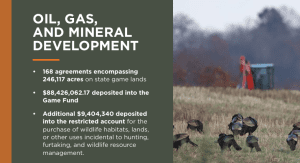
Source: Pennsylvania Game Commission Fiscal 2023-2024 Annual Report
While the PGC has demonstrated how energy development can support conservation goals, DCNR has taken a more restrictive stance. This has limited the department’s ability to fully fund the upkeep of Pennsylvania’s 2.2 million acres of state forests.
Ironically, some of the most successful examples of co-existence between energy development and conservation occur within DCNR-managed lands where legacy leases exist. These areas have shown that with modern best practices, such as multi-well drilling, water recycling, and reduced surface disturbance – natural gas development can, and does, occur with minimal environmental impact.
Yet DCNR continues to operate under a moratorium issued by the Governor on new shale gas leasing. That’s a missed opportunity for Pennsylvania’s economy and for state lands.
Pennsylvanians love their public lands– and rightly so. But maintaining them takes funding. Trail systems need upkeep. Forests require active management to remain healthy and resilient. And expanding public access requires investment. DCNR’s own impact studies have shown that for every 1 acre of land utilized for development, ten new acres have been added to the state forest system thanks to natural gas revenues.
Safe and responsible natural gas development is a proven revenue-generating tool necessary to achieving these efforts without increasing taxes or cutting corners on environmental oversight.
The Game Commission has already blazed this trail. The DCNR should take a fresh look at responsible energy development as a strategic funding mechanism for conservation. The results speak for themselves, and they’re obvious across our thriving state-managed game lands.
