




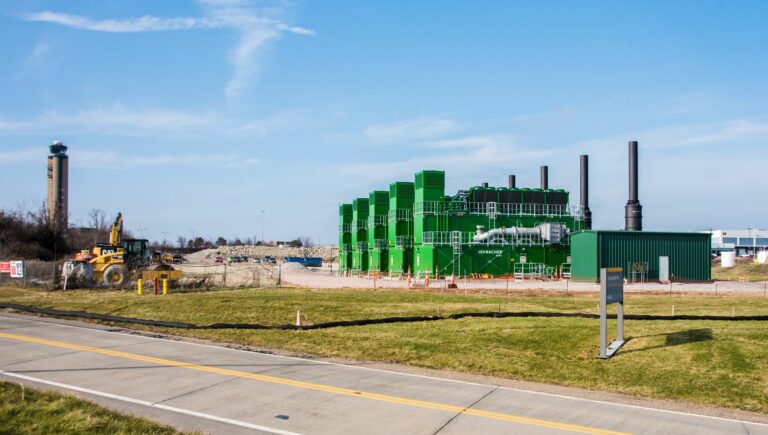
A substation fire forced London’s Heathrow Airport to go dark this March, stranding tens of thousands of travelers and forcing flights to reroute. With a world-class microgrid backed by regionally produced natural gas, travelers through the Pittsburgh International Airport (PIT) can rest assured grid failures won’t keep them from reaching their destination.
While Heathrow’s outage lasted over 18 hours and sparked global flight chaos, the PIT microgrid – fueled by five on-site natural gas wells and supplemented with solar power – generates over 20 megawatts of electricity, which is sufficient to power more than 13,000 residential homes. For reference, PIT airport’s peak demand is approximately 14 megawatts and any excess capacity from the onsite generation is sold directly to the grid to further add to reliability.
“We fully went into island mode,” said PIT CEO Christina Cassotis, recalling their own stress test in March when off-property substation fires knocked the airport off the regional grid. “It did what it was supposed to. Most people didn’t even know.”
That’s exactly the point. Natural gas isn’t just a fuel – it’s the cornerstone of modern energy security. Solar panels complement the system, but it’s natural gas that brings stability, dispatchability, and affordability.
The numbers speak for themselves. A 2023 Government Accountability Office report found 24 of the 30 largest U.S. airports experienced over 300 outages between 2015 and 2022. Only four had any form of microgrid. And just one – PIT – is entirely self-sufficient.
“[Gas] gives you resiliency you wouldn’t normally have,” aviation consultant Robert Mann said. With natural gas produced on-site, PIT avoids fuel price spikes and transmission risks. The microgrid itself saves the airport $1 million in energy costs annually, according to airport officials.
This is key because natural gas generators can ramp up instantly when the grid falters. Solar can’t perform at night, batteries are costly and limited, and wind is unreliable during a crisis.
“The Heathrow failure highlights the importance of resilient infrastructure. At PIT, our microgrid ensures uninterrupted power even when the grid is down,” Joe Broadwater, who oversees the power plant at PIT’s microgrid operator Cordia, told the Pittsburgh Business Times.
Natural gas doesn’t just keep the airport running – it’s also helping it thrive, as was highlighted during the Marcellus Shale Coalition (MSC) general membership meeting earlier this spring. CNX’s public-private partnership with the Allegheny County Airport Authority has returned nearly $100 million to the airport and County over the past decade.
And as Cassotis also told MSC members, royalty payments to the authority are a significant source of the funds for the multi-billion-dollar terminal modernization project at PIT.
“Airports are national critical infrastructure. Our goal [with the microgrid] was resilience and redundancy,” Cassotis emphasized to the New York Times.
And natural gas is delivering.
