

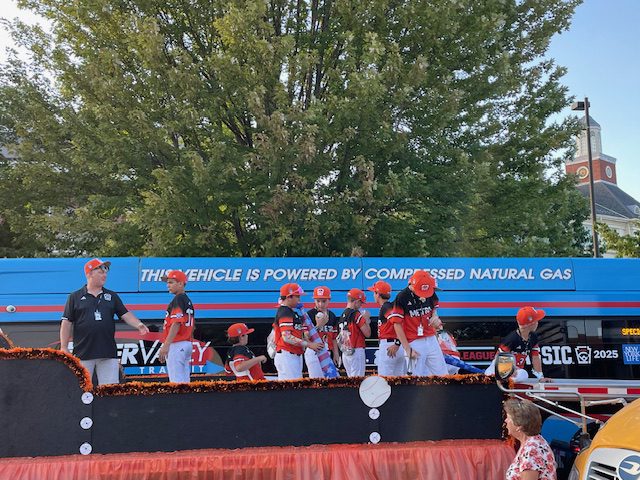
Every August, the Little League World Series attracts thousands of fans, players and families from around the globe to Williamsport, Pennsylvania – celebrating America’s favorite pastime.
It’s a big event for a small city, bringing in millions in economic activity, but have you ever wondered how all these visitors get around town?
Look no further than the regional River Valley Transit Authority – the fleet serving the Greater Williamsport and Lycoming County area – that moves players and fans using their reliable and low emission buses fueled by locally-sourced compressed natural gas (CNG).
CNG engines are a proven, cost-effective alternative to diesel, cutting tailpipe greenhouse gas emissions and harmful air pollutants like nitrogen oxides (NOx). With the power and torque needed for heavy-duty hauling, they’re well-suited for large fleets such as trucks and buses. That’s why companies and transit authorities (from Waste Management to River Valley Transit) are increasingly turning to CNG for both environmental and economic solutions.
Using CNG can save transit authorities the equivalent of $1 per gallon, according to PennDOT. For an average mass transit authority, that works out to nearly $350,000 in annual savings. That’s real savings that can be reinvested into expanded services, lower fares and other public transit priorities. These dollars stay in Pennsylvania and help our local economies thrive.
And the benefits go beyond our wallets to our collective health.
Consider, CNG buses reduce NOx emissions up to 95%, and emit virtually no particulate matter. This dramatic decrease in emissions is a public health homerun for our environment and our communities.
Williamsport’s experience has helped shape PennDOT’s understanding of how natural gas can power clean, affordable transit across Pennsylvania. River Valley Transit was one of the early adopters of this technology, showing what is possible when local resources are deployed to better meet local needs.
“The CNG buses also reduce liquid fuel costs, support jobs in the community, and increase the use of fuels generated domestically,” a PA DEP Regional Director said when RVT received its first fleet bus.
During one of the state’s largest sporting weeks, it’s fitting that buses fueled by Pennsylvania-produced natural gas helped fans from all over the world get to the ballpark quickly, safely and affordably.
The MSC and its members were proud to welcome visitors to Williamsport and proud to see our homegrown natural gas in action – delivering cleaner air, lower costs, and a winning ride for Pennsylvanians.
